As attention turns to New York New Jersey Stadium for the 2026 FIFA World Cup final, another fiercely-fought competition has been unfolding away from the pitch: the battle between FIFA’s official sponsors and the brands its commercial rules are designed to hide.
The World Cup offers exceptional global exposure and official sponsorship provides brands with visibility, access and a recognised association with one of the world’s most-watched sporting events. FIFA therefore applies strict rules to protect the exclusivity its commercial partners have paid (handsomely) for.
However, the 2026 tournament has shown that removing a brand name does not always remove the brand from public view. In the cases of Levi’s and Heinz, for example, attempts to conceal their identities instead created opportunities for reactive PR, earned media and wider public attention.
FIFA’s strict advertising restrictions
FIFA requires branding belonging to companies outside its key sponsors to be removed or covered across tournament venues and controlled areas.
Several well-known North American stadiums have temporarily lost their commercial names: SoFi Stadium has become Los Angeles Stadium; MetLife Stadium is known as New York New Jersey Stadium; Levi’s Stadium has been renamed San Francisco Bay Area Stadium.
The same restrictions extend to signage, products and commercial branding at host venues. Atlanta Stadium received a rare exemption from the rules, due to the large Mercedes-Benz three-pointed star integrated into its retractable roof, as attempting to cover it risked damaging the structure. These rules are not unique to FIFA. UEFA operates similar protections during its competitions. When Dublin hosted the 2011 and 2024 Europa League finals, the Aviva Stadium was officially referred to as Dublin Arena, a name it will adopt again for the 2028 European Championships.
Good jeans: when recognition transcends visibility
Levi’s Stadium, home of the San Francisco 49ers, became one of the most prominent examples of FIFA’s cover-up rules.
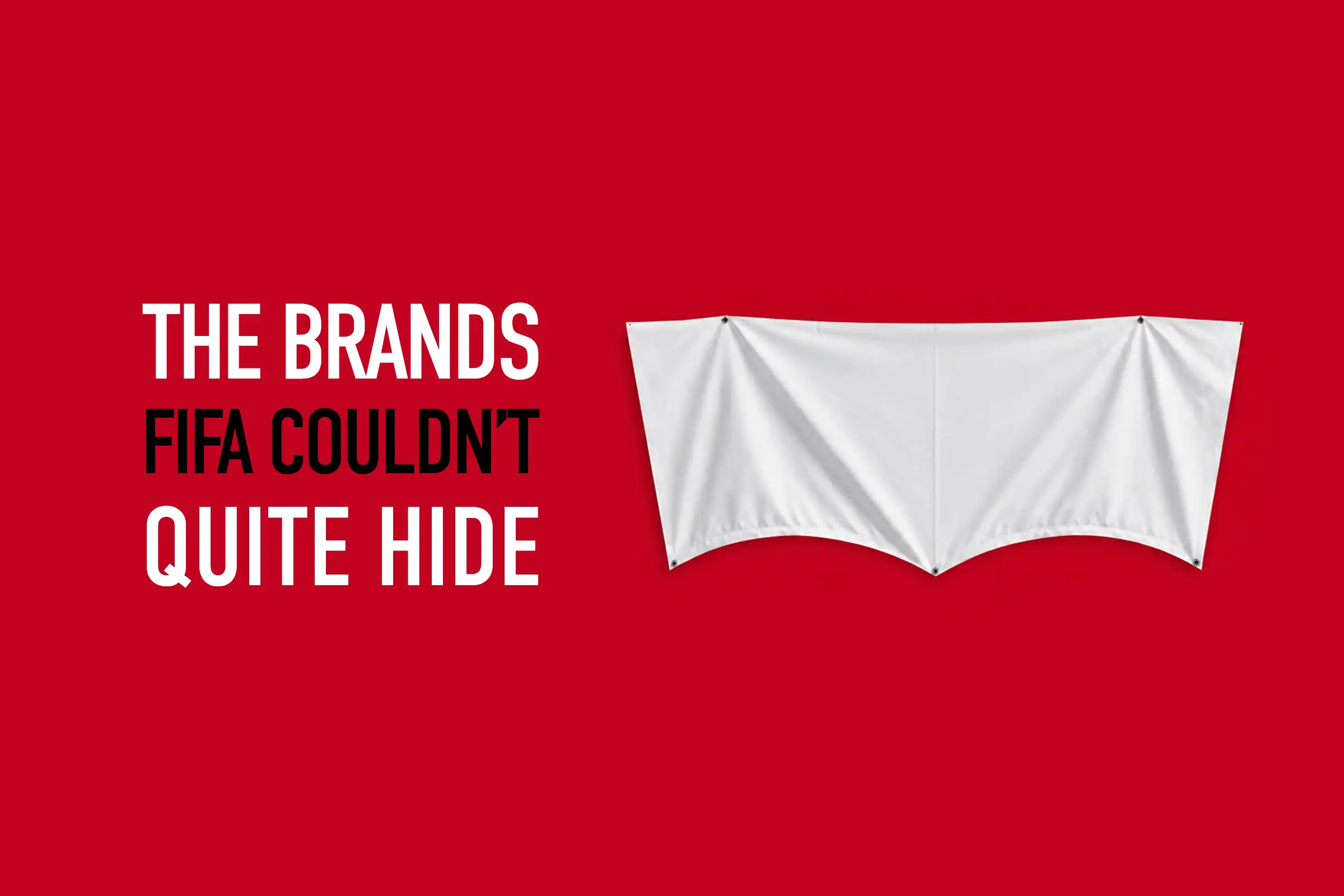
The Levi’s signage was concealed using white material cut around the shape of the brand’s distinctive batwing emblem. Although the company name had disappeared, the shape of the logo ensured that the brand remained instantly recognisable.
Rather than distancing itself from the cover-up, Levi’s embraced it. The company temporarily changed its social media profile image to an image of the white cover-up against a red background, highlighting the clever covering of the stadium signage.
Welcome to Stadium in Santa Clara, home of the World Cup and today’s match between Qatar and Switzerland. pic.twitter.com/xlAfq9Hs87
— Chris Biderman (@ChrisBiderman) June 13, 2026
The response was simple and timely. Levi’s did not need to use World Cup imagery or explicitly refer to the tournament. Audiences understood the context and completed the message themselves.
The result was a reactive PR campaign with many of the characteristics of ambush marketing. An attempt to reduce the brand’s visibility gave it a new story to tell and generated attention that ordinary stadium signage was unlikely to achieve.
Heinz: turning censorship into a product
Heinz found a similar opportunity when images circulated of condiment bottles inside suites of World Cup venues had their labels covered by tape, as these saucy interlopers were not official sponsors and therefore could not show their logo.
Heinz responded to this viral image by creating a limited-edition bottle called Unofficial Stadium Ketchup, featuring a deliberately obscured label inspired by the bottles seen at tournament venues.
The brand turned a restriction it had not created into a physical product, a social media asset and an earned media story. Like Levi’s, Heinz did not need to display its name prominently for audiences to recognise it.
Both examples demonstrate the value of distinctive brand assets. Strong brands are not identified solely by their names or logos. Colour, shape, packaging and visual design can be just as powerful when they have been used consistently over time.
When enforcement creates the story
World Cup sponsorship enforcement has created unintended publicity before.
During the 2006 tournament, Dutch supporters arrived at a match wearing bright orange trousers featuring the logo of beer brand Bavaria. As Budweiser was an official sponsor, supporters had to remove the branded clothing before entering the stadium, leaving many Oranje fans to watch the match in their underwear.
The unusual response turned what might have been a limited promotional stunt into an international news story that is still remembered two decades later.
These incidents can create a Streisand-like effect. An attempt to hide or restrict something makes it more conspicuous, encouraging audiences to discuss what has been removed and why.
Why these responses work
The success of Levi’s, Heinz and Bavaria was not simply based on avoiding sponsorship rules. It came from understanding how stories spread.
The cover-ups created curiosity, while the brands responded with humour rather than complaint. Both acted while the story was spreading, allowing them to join an existing public conversation rather than attempting to create one from scratch.
Crucially, they also gave journalists something more interesting than a conventional advertisement. The tension between FIFA’s rules and the recognisable brands being concealed provided a clear news hook and extended the campaigns far beyond the companies’ own channels.
What PR professionals can learn
Official sponsorship remains highly valuable, particularly for brands seeking global reach, credibility and formal association with a major event. However, financial investment alone does not guarantee control over public attention.
For PR professionals, the first lesson is to build recognisable brand assets. Levi’s and Heinz could participate in the conversation without prominently displaying their names because their visual identities were already well established.
The second is to be prepared to react quickly. Successful reactive campaigns still require planning, clear approval processes and creative teams that understand the brand.
The third is to give the media a story rather than another ad. The strongest responses add humour, insight or a compelling visual to an existing cultural moment.
There is also an important boundary. Brands must avoid falsely presenting themselves as official sponsors or using protected tournament assets without permission.
The 2026 FIFA World Cup has shown that attention cannot always be purchased, controlled or contained. FIFA may be able to cover a logo, but even its stringent rulebook cannot cover the public’s recognition of a brand.

About the author
Cara Conboy is a Client Executive at Cullen Communications, specialising in social media, influencer marketing and copywriting. She is also the agency’s resident football expert.